Perpetuals are crypto's one genuinely novel invention, and they're now spreading to stocks, commodities, and pre-IPO names. Here's why they won, and where they're fragile.
Anish Parvataneni · Head of Markets, FalconX · Previously Citadel, Jump Trading
July 2026
Views expressed are the author's own and do not represent the views of FalconX.
Ask any derivatives trader what crypto actually invented. Not repackaged, not tokenized, but invented. Most will give you the same answer: the perpetual future. It is crypto's one genuinely novel contribution to market structure, and it has quietly become the industry's most heavily used financial instrument. That success is now spilling well outside crypto, and I think it's worth being precise about both why it won and where it's fragile.
2025: centralized perpetual exchanges processed $85.3 trillion in volume, the most active year in the product's history.
2026: U.S. regulators approve the first perpetual futures contract on a regulated exchange, and a wave of platforms rushes to list perpetuals on stocks, commodities, indices, and pre-IPO names.
Twenty years of trading this instrument across market-making desks, hedge funds, and now an institutional digital asset platform tells me this much: it solved a real problem, and its structural weaknesses matter a lot more now that it's leaving its crypto-native home.
1993. Economist Robert Shiller proposes a theoretical perpetual futures contract for markets, like real estate, that lack a liquid spot instrument to settle against. Traditional finance never adopts it. Clearing infrastructure is built around delivery and expiration.
May 13, 2016. BitMEX launches the first perpetual swap, built by Arthur Hayes and his team. A funding rate borrowed conceptually from FX swap markets keeps the no-expiry contract tethered to spot.
2017 through 2021. Every major exchange copies the design. Perpetuals become the dominant leveraged crypto product.
2022. FTX's collapse pushes flow toward more transparent venues. On-chain perpetual protocols prove the model works without a centralized counterparty. dYdX, the early leader, later cedes almost all of that ground: its share of decentralized perpetual volume fell from 73% in January 2023 to just 7% by December 2024.
2023 to today. Hyperliquid becomes the dominant on-chain venue, capturing more than half of decentralized perpetual volume by the end of 2024 and still leading the category today, though newer entrants such as Pacifica, Extended, and Variational have already overtaken both dYdX and Jupiter.
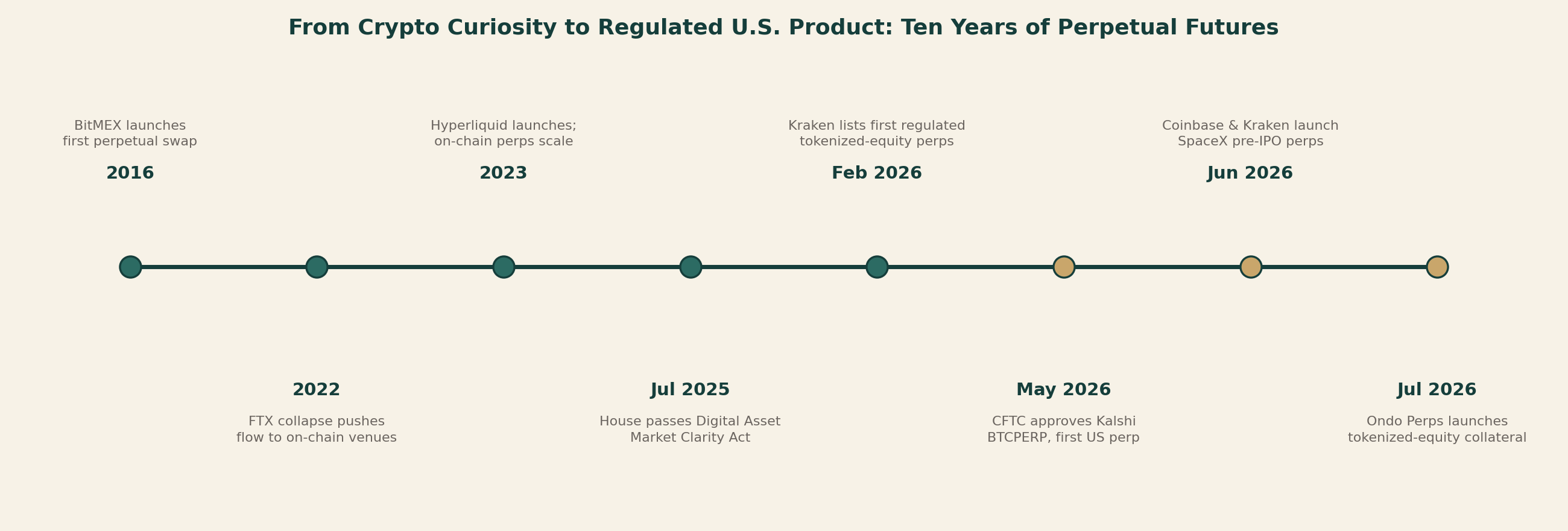
Ten years from an unregulated bitcoin workaround to a CFTC-approved U.S. product.
No expiry, no roll risk. A trader holds a view for a day or three years without repeatedly paying the spread to roll a dated contract.
Shorting, solved. A perpetual collapses locate, borrow fee, and recall risk into one instrument. Going short is exactly as easy and as capital-efficient as going long. That symmetry is core infrastructure for an asset class prone to sharp drawdowns.
Markets that never close, self-custody options, and a decade of accumulated liquidity on top.
The result: perpetuals now drive more day-to-day price discovery than spot trading itself, on most days.
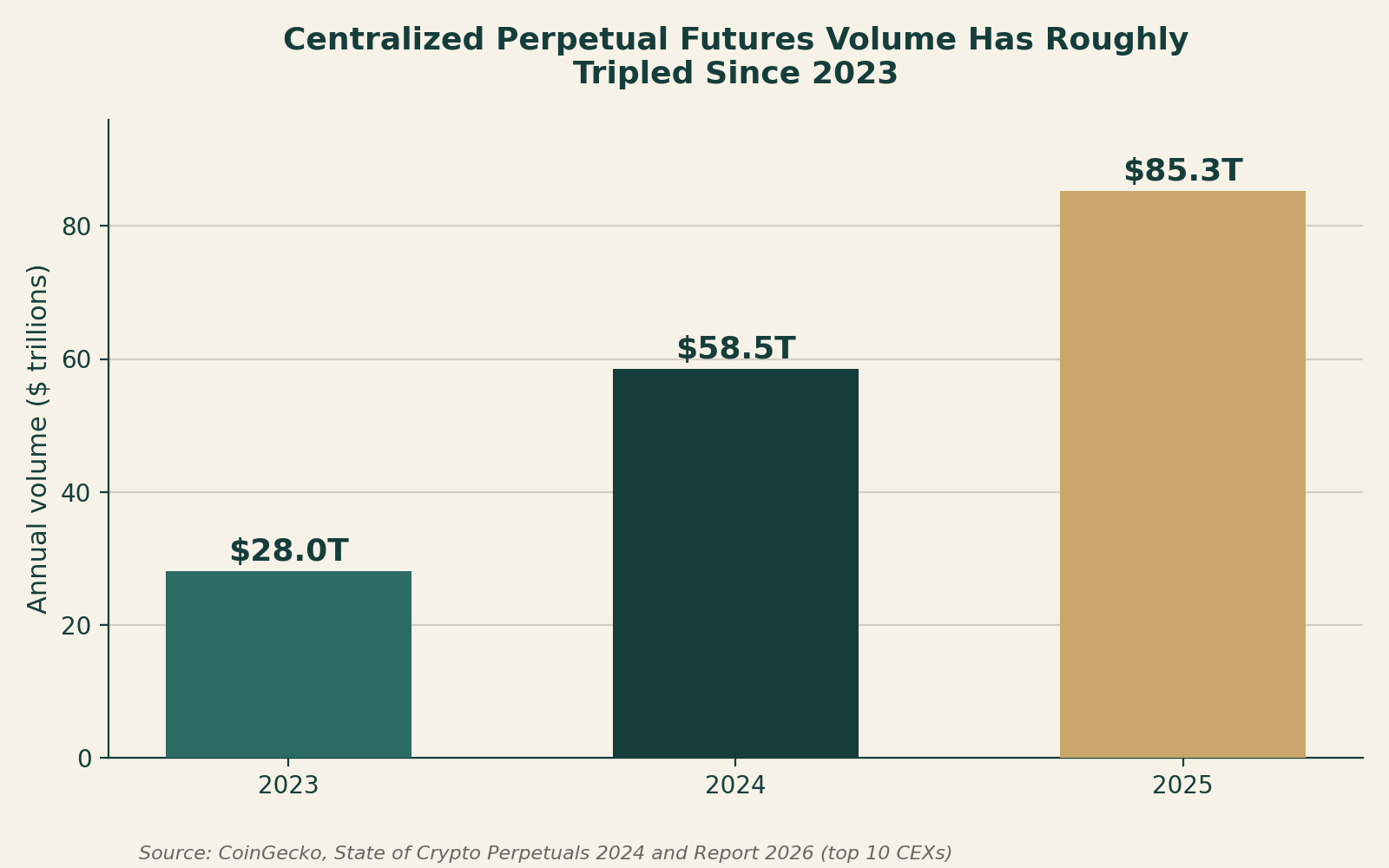
Source: CoinGecko, State of Crypto Perpetuals 2024 and Report 2026.
May 29, 2026. The CFTC issues an order approving KalshiEX LLC's BTCPERP: a cash-settled bitcoin perpetual referencing the CF Benchmarks Bitcoin Real-Time Index, the first perpetual futures contract ever cleared on a CFTC-regulated U.S. exchange. It trades continuously, with no expiry.
Alongside the approval, the CFTC published a policy statement making a point worth sitting with: perpetual contracts, in the Commission's own words, “may not be appropriate for all asset classes.” Every other exchange's application will now be reviewed case by case.
What followed was a land rush:
Kraken listed the first regulated tokenized-equity perpetual futures on February 24, 2026: up to 20x leverage on tokenized versions of the S&P 500, Nasdaq 100, gold, and names like Apple, Nvidia, and Tesla.
Coinbase launched perpetuals on Magnificent Seven stocks and ETFs on March 20, 2026: up to 10x on single stocks, 20x on ETFs.
Kraken and Coinbase both launched pre-IPO perpetuals on SpaceX in early June 2026, each capping leverage at 5x, a quarter of what they allow on public equities.
Ondo Finance launched Ondo Perps on July 7, 2026: the first platform to accept tokenized equities directly as collateral for perpetual positions, with up to 20x leverage on stocks, indices, and commodities. It crossed $2 billion in volume within a day.
The volume growth behind this has been extraordinary. Quarterly volume in perpetuals referencing real-world assets grew from $29.7 billion in the first quarter of 2025 to $524.8 billion in the first quarter of 2026, more than doubling the total for all of 2025 in a single quarter.
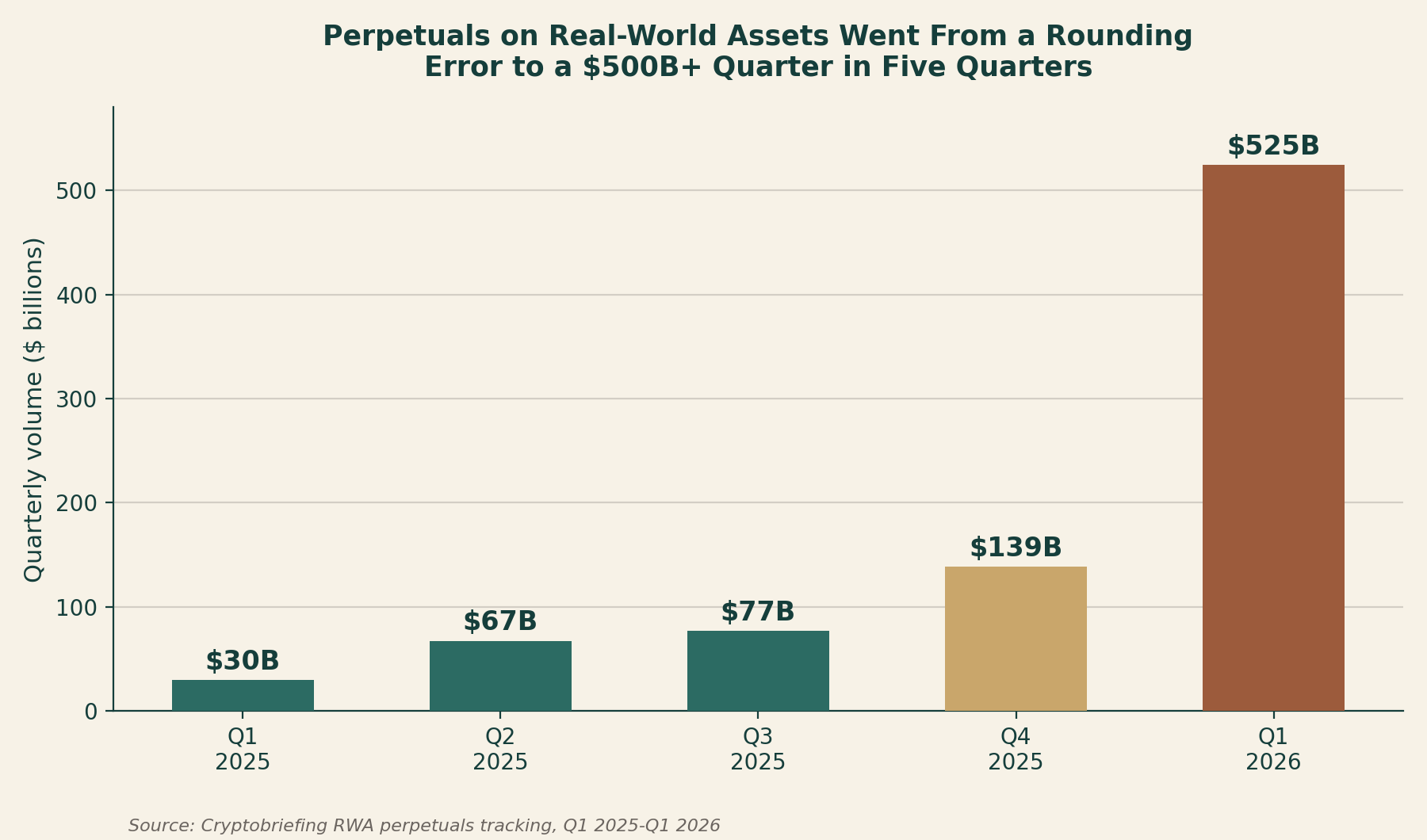
Source: Cryptobriefing RWA perpetuals tracking, Q1 2025-Q1 2026.
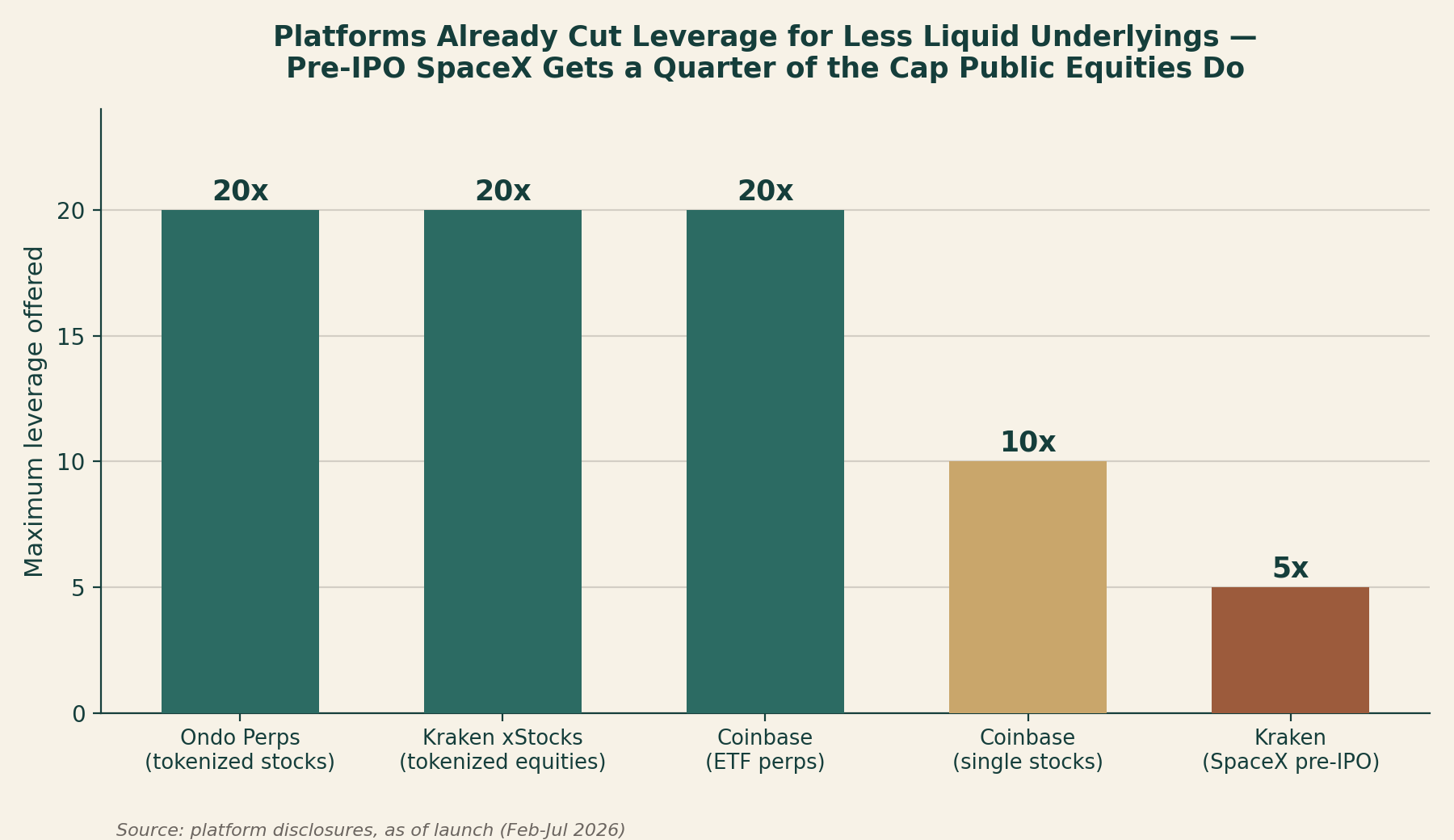
Source: platform announcements. Note the tiering by underlying liquidity.
None of this is happening in a legislative vacuum. The House passed the Digital Asset Market Clarity Act in July 2025. The Senate Banking Committee advanced its version in May 2026, and Senator Lummis released an updated floor draft on July 22, 2026.
CME is not taking the CFTC's approval quietly. It sued the agency on June 18, 2026, arguing that a perpetual is legally a swap under Dodd-Frank, not a future, and that the Commission changed course without proper process. How that case resolves will shape who gets to list these products and under what rules.
The funding rate is a continuous, structural payment between longs and shorts. It arbitrages the perpetual's price back toward a reference spot index. It is not free leverage, and it is not a synthetic that tracks for free.
Exchanges compute it from a time-weighted premium index, which blunts brief price spikes, typically capping the rate around 0.75% per eight-hour interval.
Even the cap is enormous once annualized: roughly 800% a year, on a simple, non-compounded basis, which is how the market quotes it.
The takeaway: a perpetual doesn't eliminate the cost of carrying a position. It relocates that cost from a borrow desk to a funding formula embedded in the contract.
Funding resets every few hours. In calm markets it's a rounding error. In a dislocation, it can dwarf the P&L of the original position. A trader can be right on direction and still get run over by the cost of holding it.
The clearest case study is close at hand. Funding on bitcoin perpetuals climbed from a baseline of roughly 10% annualized to nearly 30% by October 6, 2025, as leverage built up on one side of the market.
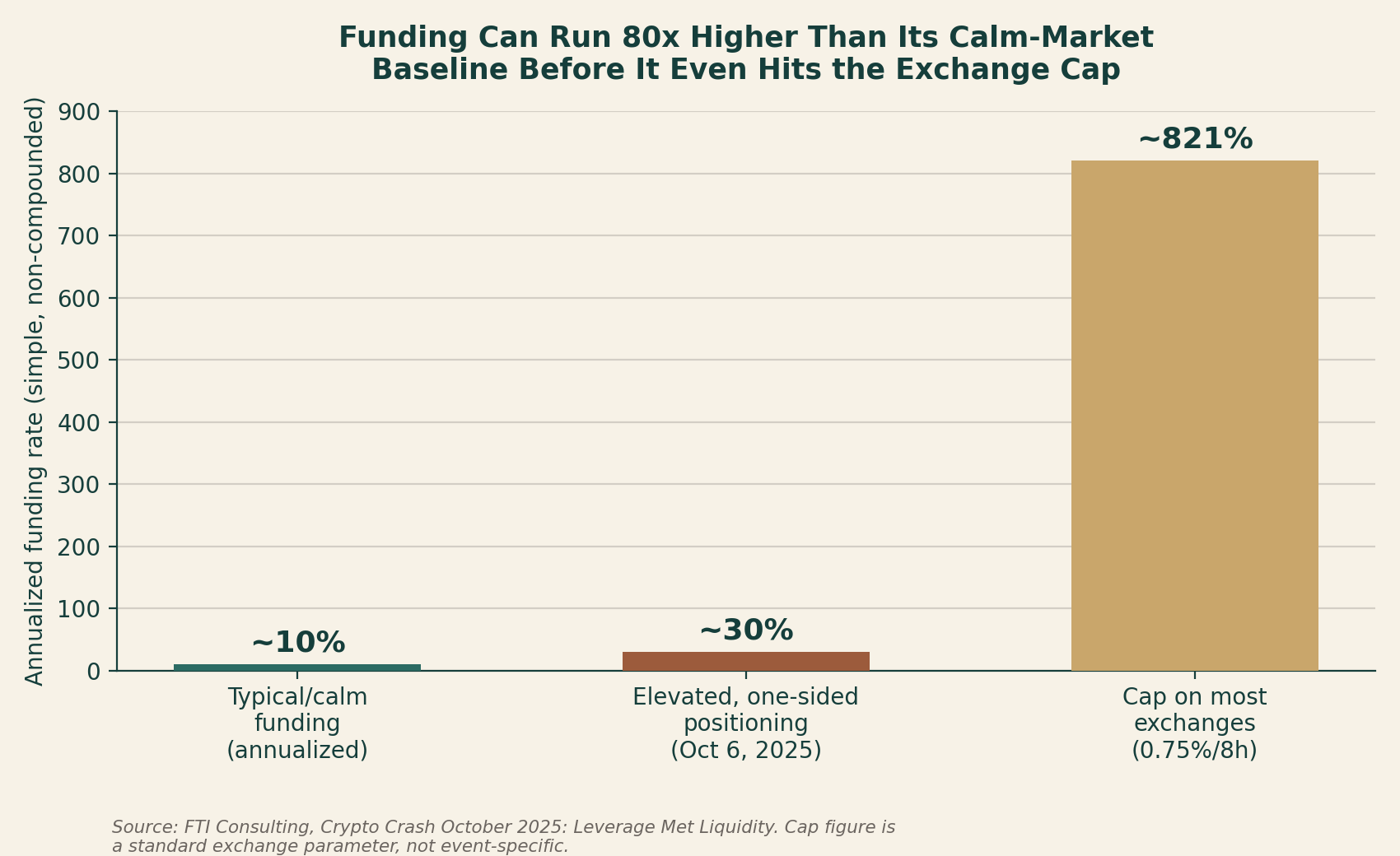
Source: FTI Consulting, Crypto Crash October 2025: Leverage Met Liquidity.
On October 10, 2025, a presidential announcement of 100% tariffs on Chinese goods, a macro headline with nothing to do with crypto's own fundamentals, triggered $3.2 billion in liquidations in a single minute and roughly $19.1 billion over the next 24 hours: the largest single-day deleveraging in the industry's history, affecting more than 1.6 million accounts.
The mechanism: a sharp move widens spreads, the mark price gaps from the index, funding flips or spikes, over-levered positions breach maintenance margin, forced liquidations deepen the move, and the next round of funding and liquidations follows.
By October 13, funding had swung to its most negative reading since the 2022 bear market bottom, a complete reversal in three days.
Scale for the year: roughly $150 billion in perpetual liquidations across all of 2025. A single day accounted for about 13% of it.
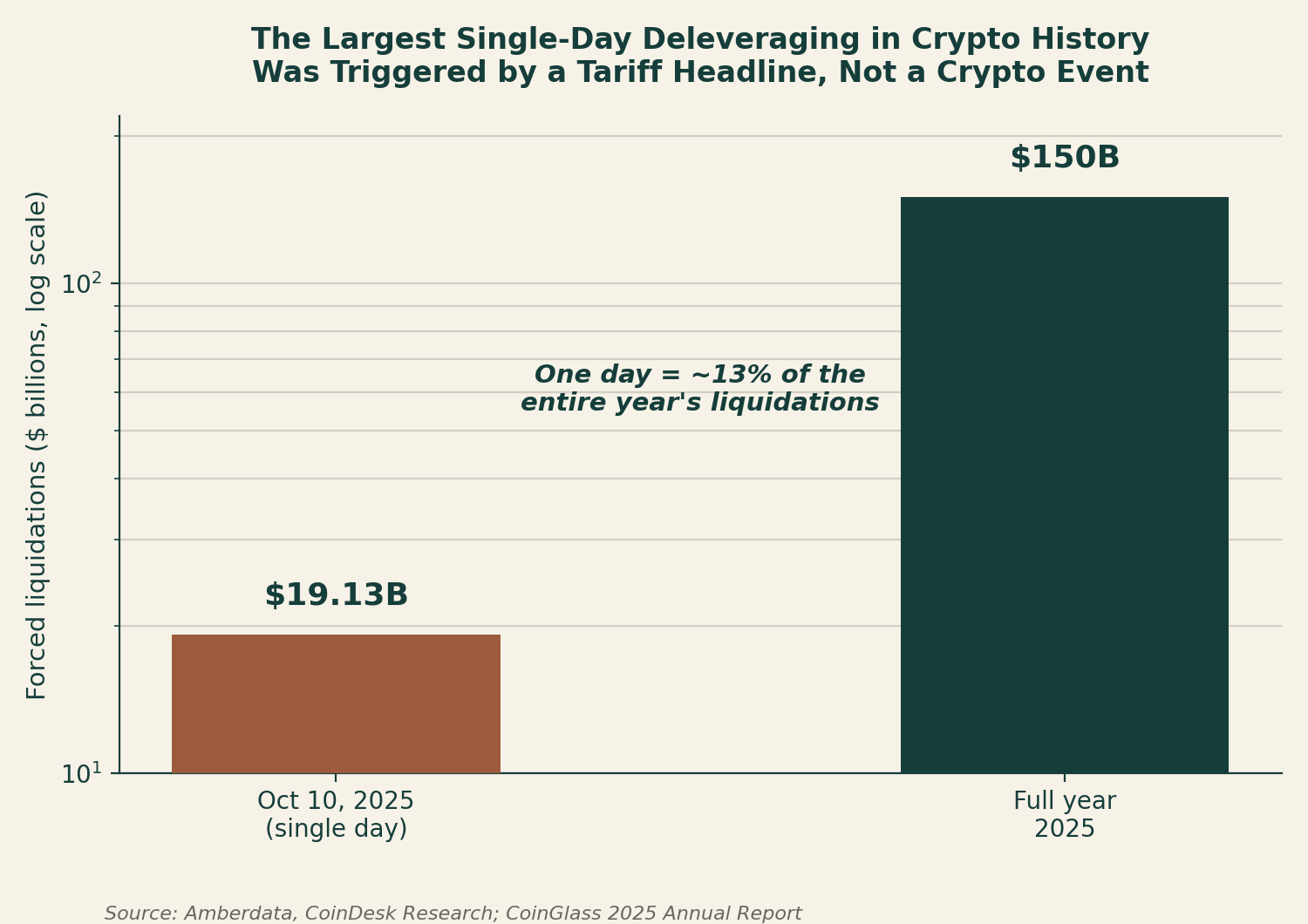
Source: Amberdata; CoinDesk Research; CoinGlass 2025 Annual Report.
The same mechanic is now being exported onto pre-IPO equity and RWA perpetuals, where underlying liquidity is thinner and dislocations are, if anything, easier to trigger.
Practical read: the funding leg needs its own risk budget, sized independently of the directional thesis, not treated as a rounding error on the trade.
A perpetual is a derivative. Its price is anchored to a spot reference index, and that anchor is only as good as the liquidity and integrity of the underlying market.
A bitcoin perpetual references a deep, continuous, globally arbitraged spot market.
A SpaceX perpetual references a private company with no continuous public market at all. Price is inferred from infrequent, opaque secondary and tender transactions.
A tokenized single-equity perpetual trades continuously against an underlying that itself only trades six and a half hours a day, five days a week, with circuit breakers the derivative has no equivalent for.
In 2025, perpetual and futures volume across CoinGecko's tracked venues topped $91.7 trillion, against roughly $18.6 trillion in total spot volume market-wide: derivatives running at nearly five times spot. The instrument regularly outstrips the liquidity of the thing it's supposed to reference.
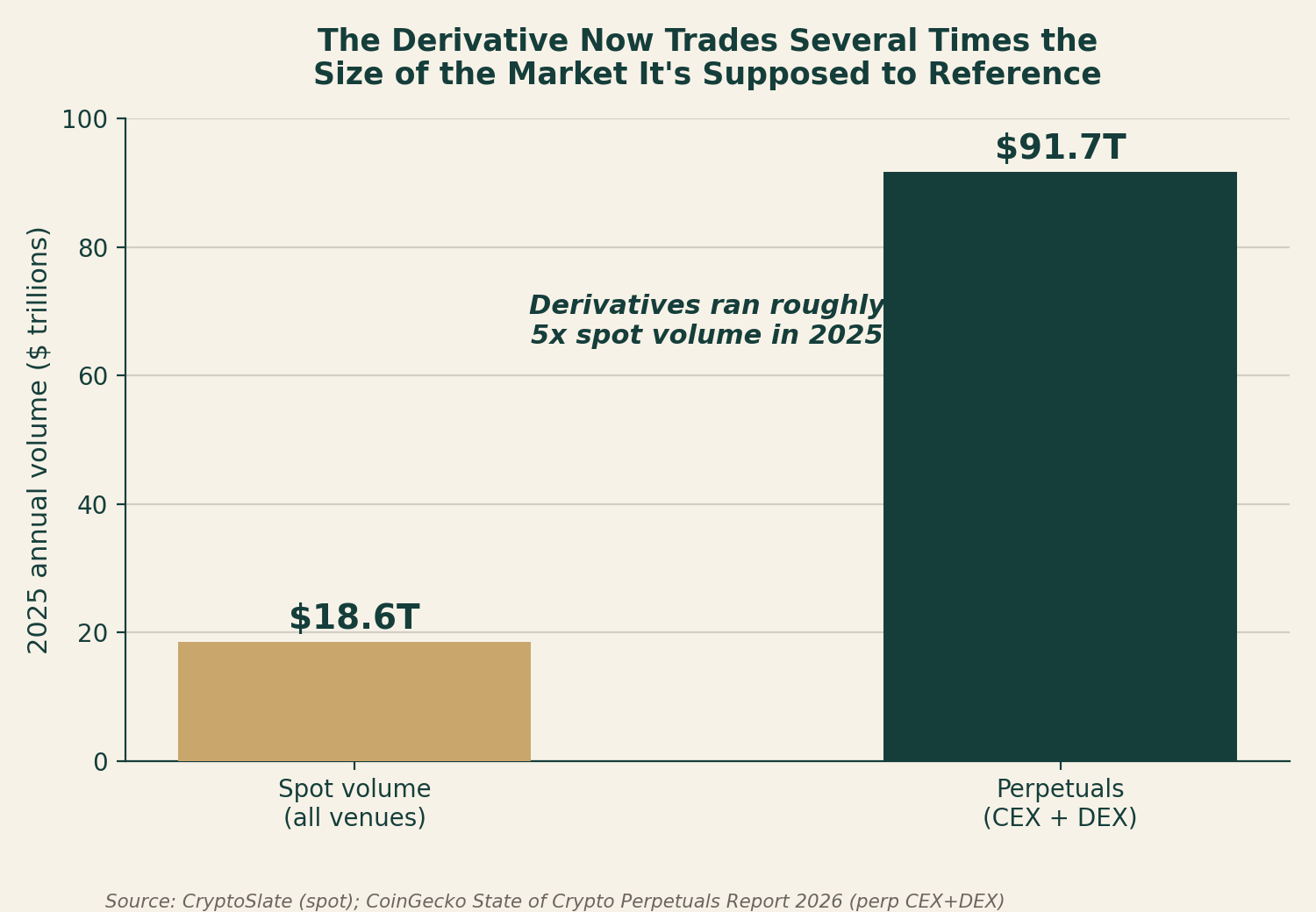
Source: CryptoSlate (spot); CoinGecko State of Crypto Perpetuals Report 2026 (perpetuals).
Funding rate manipulation is real, not hypothetical. Because funding is calculated from a sampled premium, a trader with enough capital can push the mark price briefly at the exact sampling window, extract an asymmetric payment, and unwind immediately after. Time-weighting and caps blunt this. They don't eliminate it, and thinner single-name RWA perpetuals are the easiest to move.
Wash trading is more widespread than most participants assume. In March 2026, the Department of Justice unsealed indictments against ten people tied to four firms after an undercover sting in which the FBI created its own token and waited for market makers to manipulate it. Federal prosecutors described wash trading as “far more common” than investors believe, particularly on smaller exchanges.
There is no fungibility across venues. Every exchange runs its own index construction, funding formula, liquidation engine, insurance fund, and auto-deleveraging rules. A bitcoin perpetual on one venue can't be netted, transferred, or meaningfully compared against another.
Price discovery is concentrated. Academic research on funding rate markets finds centralized exchanges show 61% higher information integration than decentralized venues, with information generally flowing from centralized to decentralized platforms. There are exceptions: for the Binance-Hyperliquid pair specifically, some studies find information flows in the other direction more often than not, a sign that the largest on-chain venues are starting to lead price discovery in their own right.
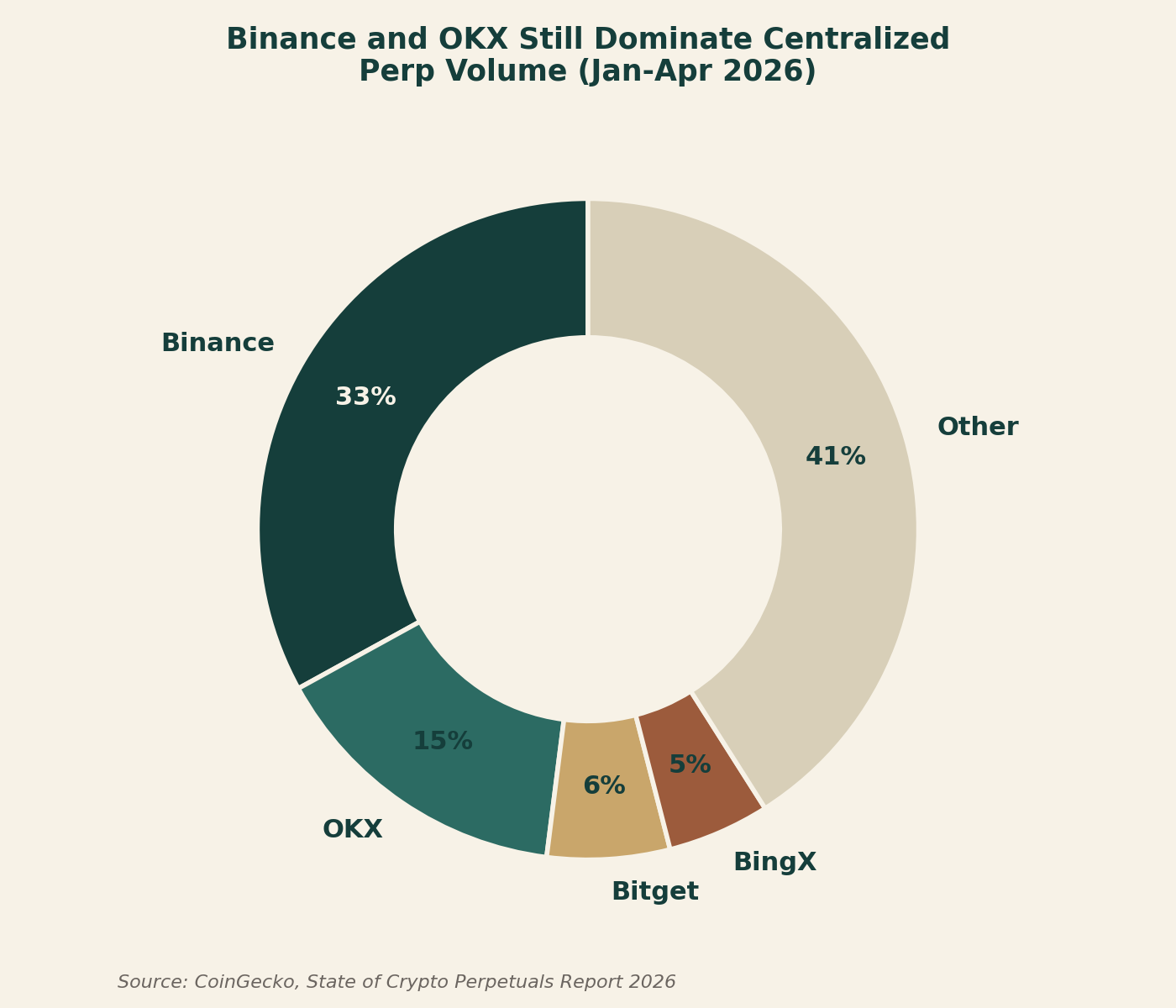
Source: CoinGecko, State of Crypto Perpetuals Report 2026.
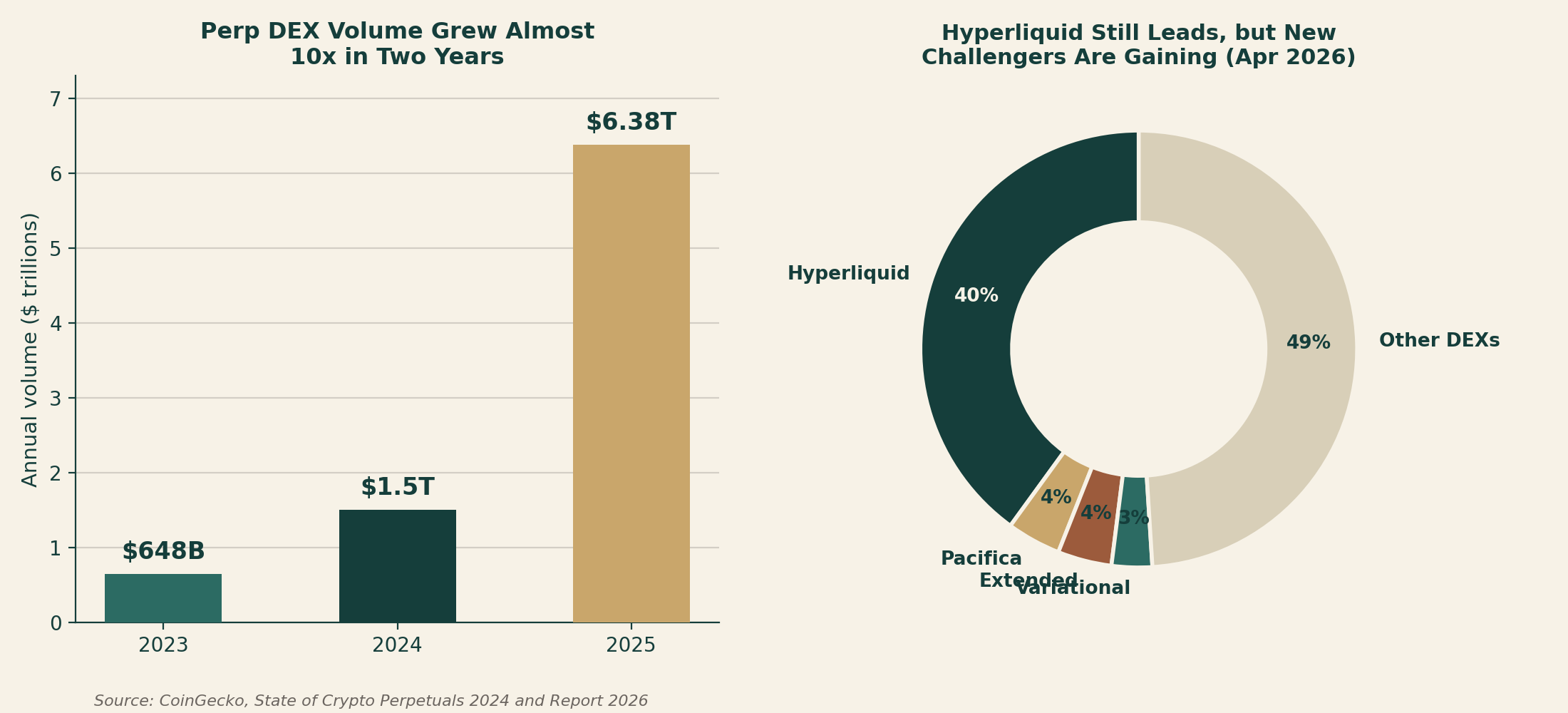
Source: CoinGecko, State of Crypto Perpetuals 2024 and Report 2026.
Perpetuals solved a real, structural problem: efficient, symmetric access to leveraged long and short exposure. They did it better than anything traditional finance built in a century of trying.
That is exactly why the wrapper is now spreading to equities, commodities, and pre-IPO names, and why that migration continues regardless of near-term regulatory noise.
But the features that worked quietly in a self-selected, crypto-native user base are a much harder sell once the underlying is something mainstream investors and regulators already have expectations about. Opaque venue rules. Non-fungible contracts. Floating-rate mechanics vulnerable to dislocation and manipulation. Derivative liquidity that regularly exceeds the underlying's own.
Even the CFTC seems to agree this needs care. Its own policy statement flagged that perpetuals may not suit every asset class, and it's reviewing further applications one at a time rather than opening the door all at once.
Expect the remaining gaps to close eventually: fungibility, standardized disclosure, funding-rate integrity, and consistent treatment of underlying liquidity. Either regulation forces it, or the market consolidates around venues that solve it voluntarily to win institutional flow.
Until then, every perpetual position is a bet on the venue's rules and discretion as much as on the underlying itself, whether it's crypto-native or freshly wrapped around a real-world asset. Know exactly what you own, and what happens to it when funding stops behaving.
